
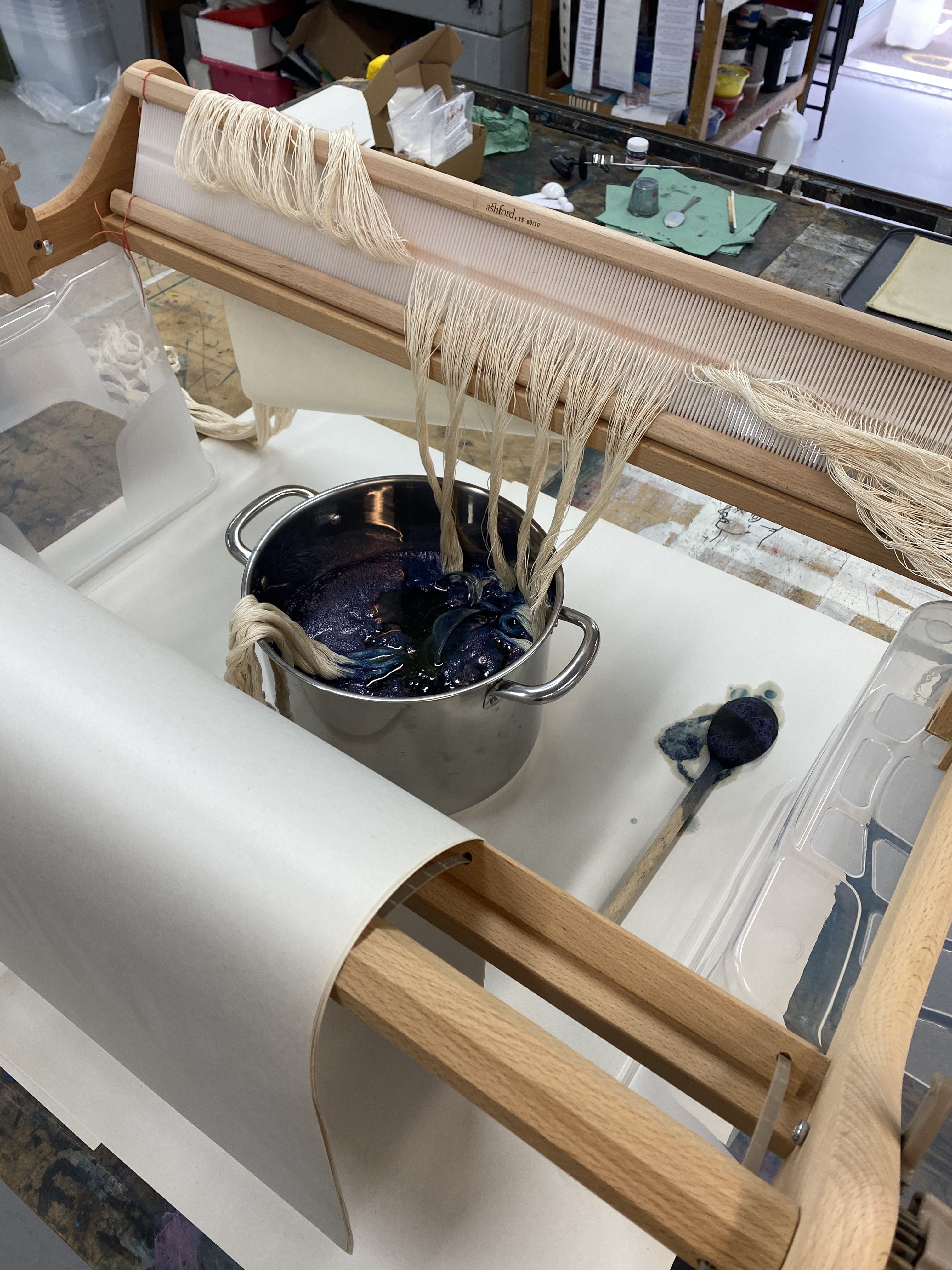
I was going to write this entry yesterday, alongside the session I had booked to dip-dye the warp of my weaving project, but I was in no fit state to write. My nerves were on edge. I experienced a major panic with the work that I had not been expecting, but now with a night’s sleep on it and having come out positively on the other side, I feel I can now jot down my thoughts.
Focus of the day was to create a woad vat from extract and then release the warp on my loom in order to dip-dye the middle section. This is the second project where I have dyed or painted the warp on the loom. The first being painting the warp with ink made from madder. In order to do the same with woad, I need a different approach, as it is not possible to ‘paint’ the dye onto the warp. For the dye to latch onto the fibres a vat must be produced and kept at a constant temperature (35-40deg), it then needs to be reduced with an agent (in this case Thiorox) and only then is the dye stuff in a state that it can adhere to the fibres. When dipped for about 15 minutes it is then briefly immersed in a warm water bath and then removed to expose it to the air. It will then turn from a limey green/yellow to the denim blue that woad is sought for.
I arrived nice and early to prepare the vat, which went according to plan and very similarly to the time before in studio 27. I was again using the extract that I bought from DT Crafts. I had the option to reuse the old vat which I have been successfully storing in a plastic tub, or to use the naturally extracted vat currently up in conservation lab, but given that both of these had had significant use, I felt it was better to have a strong vat produced from scratch to ensure a successful dye.


Once the vat was almost ready and reducing nicely for the 45-60minutes, I collected my loom with the warp already threaded from the last project. My task was to secure the warp and then unwind it from the loom to release enough thread for dipping. I did this by loosely tying groups of warp threads within a shed, thus keeping them in order. I then released the wound on warp from the back beam. This is where is all went wrong!
The tension released from the warp and all the threads bounced around and crossed over, making a loose and precarious tangle. I tried to move the heddles out of the way and get some order back into the loom, but the more I touched the threads the more they tangled and bunched in all the wrong places. I stood back and a wash of dread took over me. “I think I have just messed this whole thing up”, I told Sian, the technician kindly supervising me in the room.
At this point I felt I had two choices: 1) start the whole project over again, re-warping the loom. This meant cutting the whole thing off the loom and throwing away the hours of work done so far. 2) forgetting the project all together and omitting it from the exhibition. Neither was ideal, in fact I was devastated at the thought of either one. I have limited time left to produce this piece as it is, let alone start over, and the materials I will have wasted in doing so made me feel sick. How can I say I have a sustainable practice when I just throw it away?
I cried…..I panicked…..
Sian was great in talking calmly about what we can do. “Do you want a cup of tea?”….”Do you need to step away from it for a bit?”…..”Talk me through your options”. She openly admitted that she has no experience in the processes I was using and couldn’t offer specific technical guidance. I had known this and was simply needing her there as a member of staff in the room for H&S. Whilst this is true, her experience in working through projects of all kinds within the school of arts was certainly of great value to me, and it was her ability to see things methodically and calmly, without the emotional involvement was exactly what I needed right then. I was so upset.
This has led me to reflect on how I react to adverse moments within my practice. I recognise that I am an emotional person, I feel things keenly and care deeply about what I am doing. I can be prone to a perfectionist viewpoint and this can lead to a massive crash when things don’t work out the way I had planned. I can fall into catastrophising the situation and being blind to finding the way through.
After allowing myself a moment to cry and feel what I needed to feel, I started to process what Sian was suggesting and slowly began to talk through what had actually happened and what I might need to do to try and fix it. I knew the tension had totally gone from all the threads and that they were tangling behind, within and in front of the heddle. The threat was that they could all come out of alignment and become so uneven that I would lose most of the weavable length in the warp.


I slowly looked at the first bunch of threads and tried to wrangle them into order and hold the tension from the back beam again. It was awkward, slow and painstaking, but I was able to do it and, as both Sian and I noted, was much like trying to comb a little girl’s hair without them noticing any tangles. Every move was careful and slow, but it was working.
When Sian watched me successfully do the first bunch, she suggested she helped from the other side of the warp and we worked together to re-tension the whole thing. This took the best part of 1-2 hours and ran us into a late lunch. I had hoped I would have completed my dip-dyeing by now and the vat was patiently sitting and waiting for me to get to the main moment of the day. Yet here I was un tangling thread by thread, sometimes on a roll with it, other times cursing the seeming impossibility of the task. 1.15pm and we had successfully untangled and secured all the threads. Not out of the woods yet, but at a point where I could see the possibility of saving the project, an option 3, that was far preferable to the bleak prospects I had imagined before.
I took a deep, sighful breath and whilst my panic still wanted me to keep going until I had successfully completed the task, I knew we both needed a lunch break and I needed to create a little distance for a while and take stock. This step away, whilst I wanted to resist it, was such an important thing for me to do. I learnt that it is so easy to be absorbed into the work so that you don’t look after yourself, or allow space to think things through clearly.
As an artist I want to do new things, push my boundaries, challenge myself, and this is great. However, I need to sometimes recognise that for this to work and be sustainable, I need to be able to step back and think, allow for failures and mistakes, and use them rather than discard them or cover them up with a kind of shame. I think I somehow feel that if I am caught making mistakes and failing, someone will come around and say “you don’t know what you are doing, do you? You are not a real artist. This isn’t for you.” This is not true. I know this, but I find it hard to practice doing-knowing this. Today taught me that I need to have these moments and I need to have the resilience and bravery to sit in them and then work through them. The outcome may be different to my imagined plan, but persevering with what I have and solving problems as I go, this is where I will learn and where I will exercise my artistic creativity and skill.
Another thought on this moment was the agency of the materials themselves. Something I am keen to learn more about, moving forward in my work. I am not the master of the materials I employ for my artworks, I am working with them and I have to understand them and what they are want to do. The tension held in these threads meant that when released they wanted to spring back and recoil. I needed to understand this and be more observant of where I could support the warp more effectively. I have watched people release the threads on the warp before, but I had misunderstood the need to keep the threads clamped by the back beam so they cannot slip out of alignment.
Future steps are to practice on narrower and simpler projects, releasing the warp from the frame for painting or dyeing. Seek out more examples of others working with this technique. Investigate the alternative method of indirect warping and dyeing the warp before it is threaded onto the loom.
Funnily enough the comparison I can make between the tensions in the threads releasing and recoiling and the tension that I have clearly been holding in my pursuit of producing a project that I am happy to submit for exhibition and assessment, and meeting the demands of the MA in general are evident. Perhaps I needed that release and reset to focus on what matters at this stage and clear my mind for the weeks ahead.