
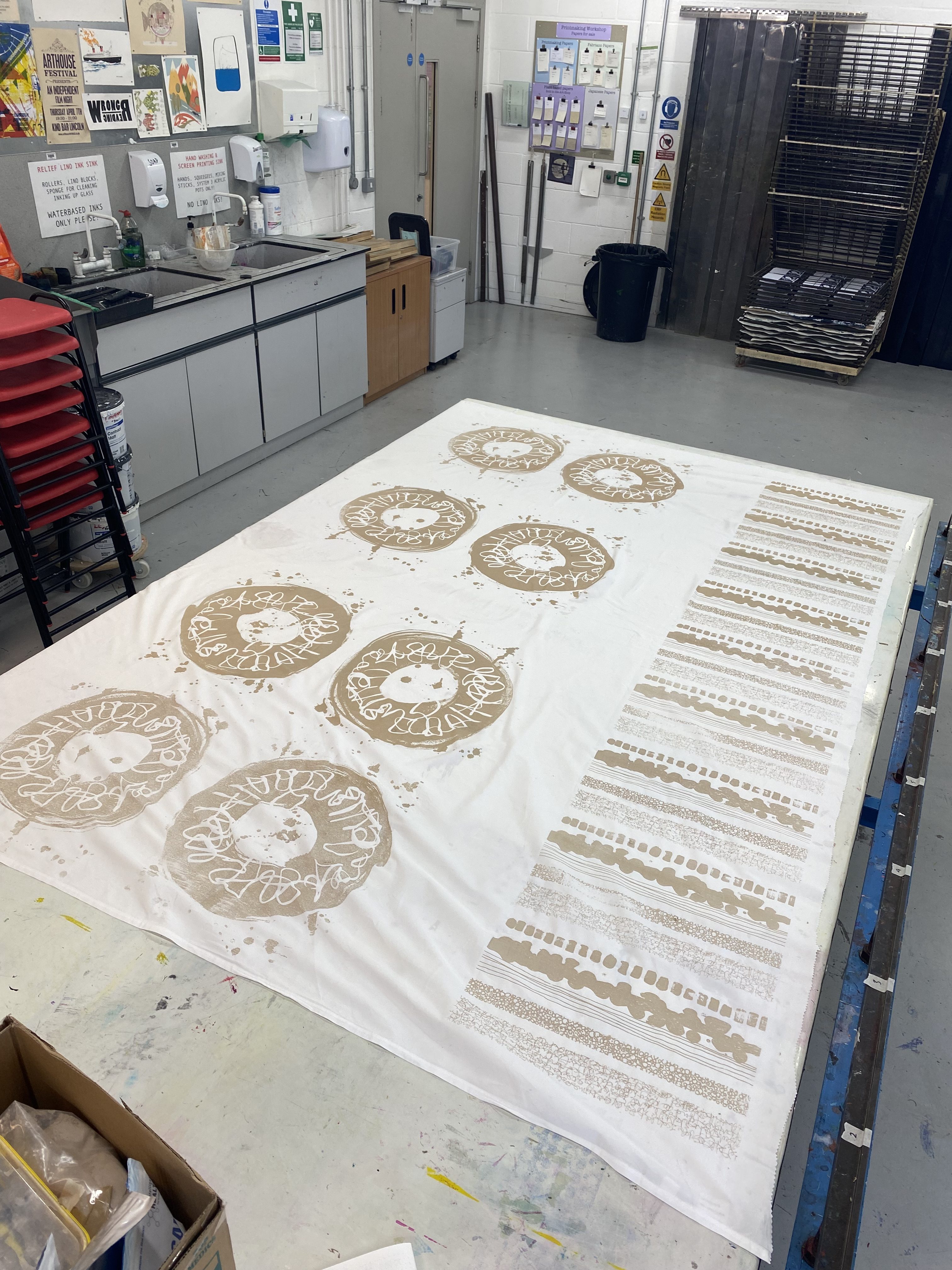


Happy with the results of the previous clay resist tests (see: Screen Print Clay Resist – Test and Resist Paste Test: steaming the cloth), I returned to the print workshop to make my screen prints for the woad vat dip-dyeing experiment.
I followed a similar recipe but to make sure I had enough for the entire work I followed this recipe:
-125ml Epsom salts
-250ml Hot water
-375ml Kaolin/Bentonite clay mix (50/50)
-15ml Indalca
Printing went well and I was able to achieve a full run of the original striped design from my test screen (I taped off the script circle). I learned how to set up a full run of fabric for a repeat, marking off the bar at intervals measuring the width of the design and then printing every other repeat, before letting it dry and then returning to fill in the gaps.
A challenge with the paste is that it dries quickly and therefore it is necessary to wash out the screen at least after two prints. It didn’t help that we were experiencing a heatwave which exacerbated the problem. I got into a flow by swapping between the large screen with the circle, and printing the run of stripes. At least the conditions caused the screens to dry quickly after washing, and the clay solution washes out more easily than traditional screen printing ink, which is acrylic based.

After the print run was complete it was hung up to dry in the BA studio, where I have now been afforded some extra workspace since the undergraduate students have finished for the year.