
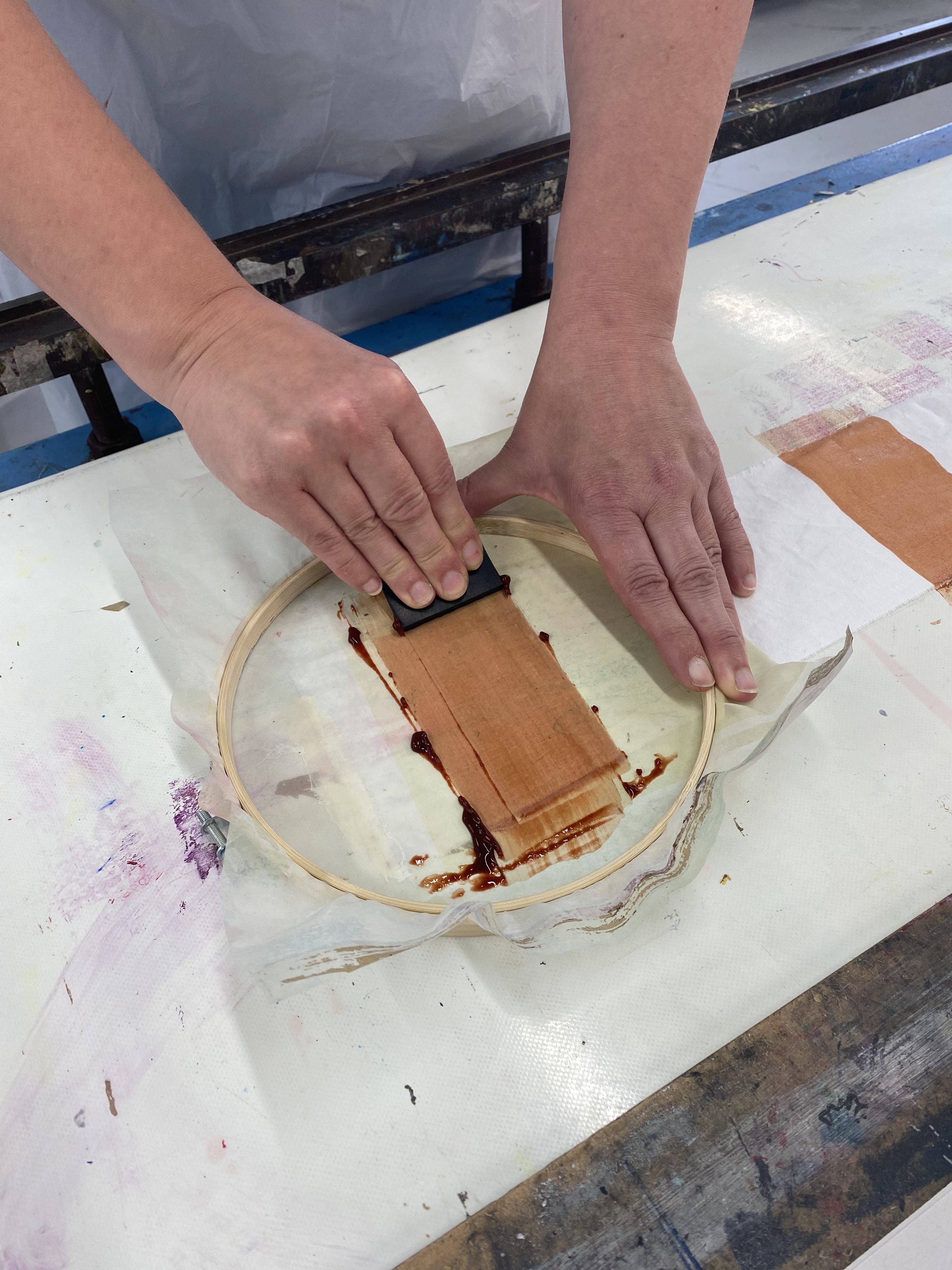
Leading on from my experiments and learning about natural dyes (see Natural Dying with Polly Lancaster), I wanted to develop a way of screen printing with these inks. Looking into this it would involve thickening the ink in order to pass it through the sceen.
I used the following recipe adapted from Jacqui Symons’ book From Plant To Print
– ready made dye solution (from Studio 27)
– dissolve 5g allum sulphate in
– 50g hot water (adapt quantity according to dye solution volume)
– 50g vinegar
– guar gum to thicken (I also bought gum Arabic, which is mentioned in other books as a thickener – will test both)
Made 2 batches as was not sure if gum arabic would be better than guar gum. Tested them through a screen swatch to make sure it would not block the mesh.


Made a few test pulls through the screen swatch with a small piece of squeegee rubber in all three colours: logwood (purple), madder (red) and knopper gall (brown).

Finally we ran some tests through a ready made screen with fine lines to see how the ink behaved with the detail. The pulls were really clean and clear.
next stage was to take this information and go and design the screens I would be using for my final work. I used the MAC Lab to convert a previously produced artwork of circular script into a black and white file. I also created an A3 page of ink marks and sharpie drawings to get a variety of marks in a stripe pattern. Each of these was printed onto lightweight copy paper and oiled to create an exposure template for creating the screens.
Additionally I worked on some drawings I created with walnut ink and India ink. These were enlarged and adapted to make good solid black and white .psd (photoshop) files that would still give the essence of the brush strokes. These were printed upstairs on the large format printers to fit the largest screens.


